Keepsakes
The Boudoir Photo Book: Formats, Paper and Care
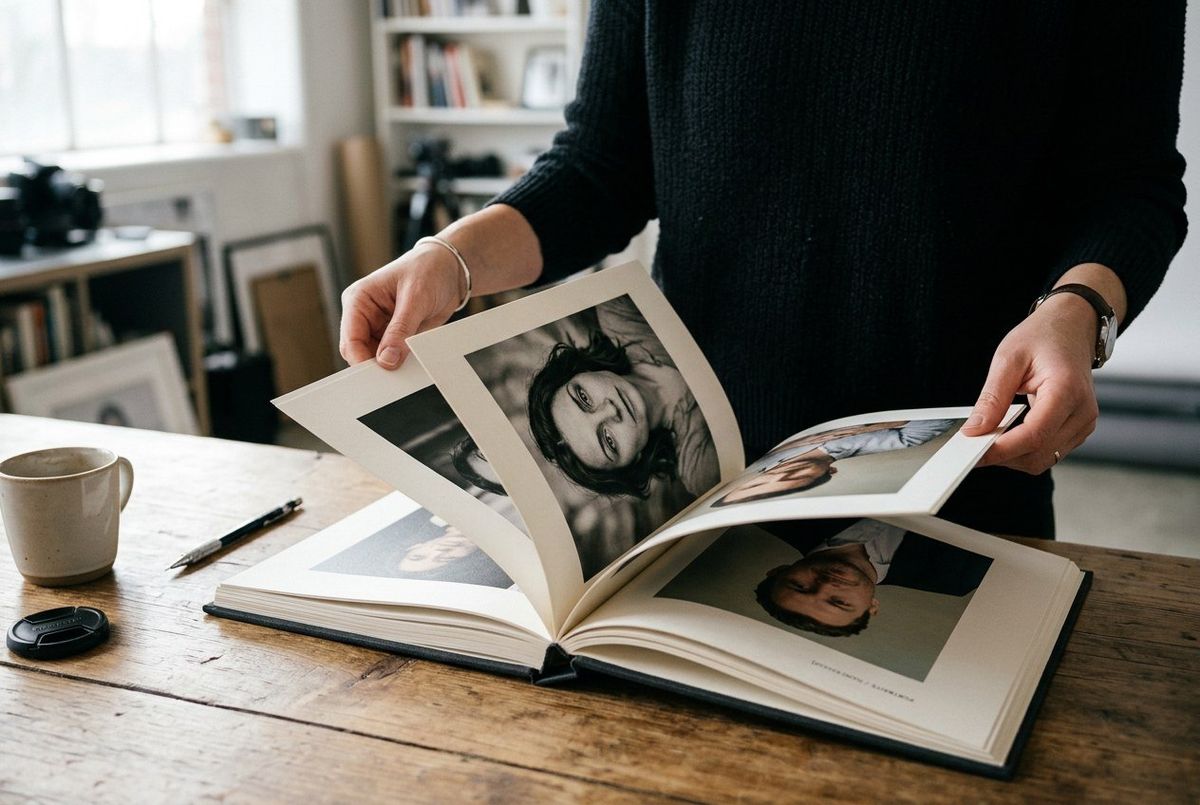
For many people the album, not the screen, is the point of a boudoir session. Here is how a good one is designed, printed and kept.
A boudoir session usually produces dozens of finished images, and most of them end up living in a folder nobody opens. A printed book changes that. It turns a set of files into an object with a beginning and an end, something private that can sit in a drawer for twenty years and still look the way it did on the day it arrived. If you are planning a session, or deciding what to do with images you already have, it helps to understand the options before anyone sends a file to print.
Photo book, album or folio: the three formats
The words get used loosely, but there are three distinct products.
- Printed photo book. Pages are printed on a press, usually digitally, and bound like a hardback book. The pages are thinner and turn like a book. This is the most affordable route and works well for 20 to 60 images.
- Flush-mount (lay-flat) album. Each spread is a photographic print mounted on a rigid board, so the pages are thick and open completely flat. A single image can run across both pages with no gutter cutting through it. This is the traditional "heirloom" format and the most durable.
- Folio box. Loose, mounted prints kept in a clamshell box. There is no fixed order, which some people prefer: you can pull out one print, frame it later, or rearrange the set.
None of these is better in the abstract. A lay-flat album suits a set that has a strong narrative and a few wide, atmospheric frames. A folio suits a set made of strong individual portraits. A printed book suits a long, varied edit.
Choosing the images
The edit matters more than the binding. A tight selection of 20 to 30 images almost always reads better than 70 near-duplicates. When you go through the gallery, look for variety in three things:
- Distance. Mix wide frames that show the room and the light, mid-length portraits, and close details such as hands, fabric, a necklace or the edge of a window.
- Mood. Most sessions move through a few setups. Keep at least one or two images from each so the book does not feel like one long frame.
- Expression. Choose the frames where you look like yourself. A technically perfect image with a forced expression is the one you will skip every time you open the book.
Detail shots do a lot of quiet work. A close-up of a silk robe draped over a chair, or light falling on a dressing table, gives the eye somewhere to rest between portraits and keeps the book tasteful in tone.
Sequencing: how a book should flow
Sequencing is the difference between an album and a slideshow. Experienced designers tend to follow a few simple rules:
- Open with a strong, calm image that sets the mood, often a wider frame.
- Group images by setup or wardrobe, so each section has its own palette.
- Pair images on a spread that share a color or light direction; avoid putting a bright, airy frame opposite a dark, moody one unless the contrast is deliberate.
- Let one image have a spread to itself every so often.
- Close with something quieter than the opening, so the book ends rather than stops.
If the photographer designs the layout, ask to see a proof of every spread before it goes to the lab. Check the gutter on lay-flat albums and the trim on printed books: faces and hands should never sit within a centimeter or two of the edge or the fold.
Paper, finish and cover
Paper choice changes the feel of the whole set. Matte or lustre finishes are the usual choice for boudoir work. They handle soft skin tones and deep shadows well, they do not show fingerprints, and they avoid the glare of glossy stock in lamp light. Fine-art cotton papers give a softer, textured look that suits muted, film-like editing. Metallic or high-gloss papers increase contrast and can look striking with dark, low-key images, but they also exaggerate retouching and can feel commercial.
Covers range from fabric and linen to leather, leatherette and printed photo covers. For a private keepsake, many people prefer a plain fabric or leather cover with no image on the outside, so the book can sit on a shelf without announcing what is inside. A small debossed initial or date is a common compromise.
Privacy at every step
A photo book is a physical copy of private images, so it is worth asking how it is made. Most professional albums are produced by specialist labs that print for photographers, not for the public. Reasonable questions to ask include:
- Which lab prints the album, and is it a professional trade lab?
- How are the files transferred, and are they deleted from shared folders after printing?
- Will the album be delivered in person, collected, or posted in plain packaging?
- Will any spread be used as a sample? If so, that needs your separate, written consent.
The broader rules on who controls images after a session are covered on the consent and privacy page. In the United States, the photographer generally owns the copyright in the images they create unless a written agreement says otherwise, which is why the contract should spell out what can and cannot be done with them. The U.S. Copyright Office explains the basics in its Copyright Basics circular.
Making it last
A well-made album should outlive the device you viewed the gallery on. Archivists give consistent advice for storing photographs at home: keep them somewhere cool, dry and dark, away from attics, basements and outside walls, and handle prints with clean, dry hands. The Library of Congress guidance on care, handling and storage of photographs and the National Archives page on caring for family photographs both recommend stable conditions and storage materials that are free of acids and PVC. Store the book flat or upright with support, and keep it in the box or sleeve it came in.
Keep the digital files too. A book is a lovely way to see the images, but it is not a backup. Save the full-resolution files in at least two places, one of them offline, so a replacement can be printed if the book is ever damaged.
Gift or keepsake?
Boudoir books are often given as gifts, for a wedding or an anniversary, but plenty of people make them purely for themselves. It is worth deciding which it is before you choose images, because it changes the edit. A book made for yourself can be more personal and less polished. A gift tends to be shorter and built around the frames the recipient will love. Either way, the person in the photographs decides what goes in and who sees it.